Dental Implants in Turkey: Two-Visit Treatment Explained
Dental implants are a popular option for replacing missing teeth, but the treatment usually involves more than one appointment. For international patients travelling to Turkey, understanding the treatment stages is particularly important when planning flights, accommodation and time away from home.
A common approach is the two-visit dental implant treatment plan. During the first visit, the dentist performs the necessary examinations and places the dental implants. After a healing period, the patient returns for the final crowns, bridges or other permanent restorations.
But why are two visits often necessary? How long should you wait between appointments? And what happens during each trip?
This guide explains how two-visit dental implants in Turkey work and what patients should consider before travelling.
What Are Two-Visit Dental Implants?

Two-visit dental implant treatment is an approach in which implant surgery and final restoration are completed during separate trips.
It generally involves three stages:
- First visit: Examination, treatment planning and implant placement.
- Healing period: The implant integrates with the surrounding jawbone.
- Second visit: The dentist checks healing and fits the final restoration when appropriate.
This staged approach allows the implant to heal before it is exposed to the normal forces associated with chewing.
The exact treatment plan depends on the patient’s dental condition, bone quality, number of implants and whether additional procedures are required.
First Visit: Examination and Dental Implant Placement
The first visit is usually focused on preparing for surgery and placing the implants.
1. Initial Dental Examination
Before treatment begins, the dentist needs to assess your oral health and determine whether implants are suitable.
The assessment may include:
- Examination of the teeth and gums.
- Review of your dental and medical history.
- Dental X-rays.
- A 3D CBCT scan when clinically indicated.
- Assessment of jawbone volume.
- Evaluation of your bite.
- Discussion of treatment options.
The dentist should explain the proposed procedure, possible risks, alternatives and expected timeline.
2. Treatment Planning
After the examination, the dentist develops an individual treatment plan.
This should explain:
- How many implants are recommended.
- Where the implants will be positioned.
- Whether extractions are needed.
- Whether bone grafting or a sinus lift may be required.
- Whether temporary teeth can be provided.
- How long healing may take.
- When the final restoration may be fitted.
A written treatment plan is particularly important for patients travelling internationally.
3. Dental Implant Surgery

During implant surgery, the dentist places a small implant fixture into the jawbone.
The implant acts as an artificial tooth root and provides support for a future crown, bridge or full-arch restoration.
Depending on the complexity of the procedure, treatment may involve:
- Local anaesthesia.
- Tooth extraction.
- Preparation of the implant site.
- Placement of the implant.
- Bone grafting, if necessary.
- Placement of a healing component or covering screw.
- Sutures where required.
The procedure varies depending on the number and location of implants.
4. Temporary Teeth During the First Visit
Some patients may receive temporary teeth during their first visit.
These may be removable or fixed, depending on the clinical situation and treatment design.
However, immediate temporary restoration is not suitable for everyone.
The dentist must consider implant stability, bone quality, bite forces and the overall surgical plan before deciding whether immediate loading is appropriate.
Temporary teeth should not be confused with the final permanent restoration.
What Happens Between the Two Visits?
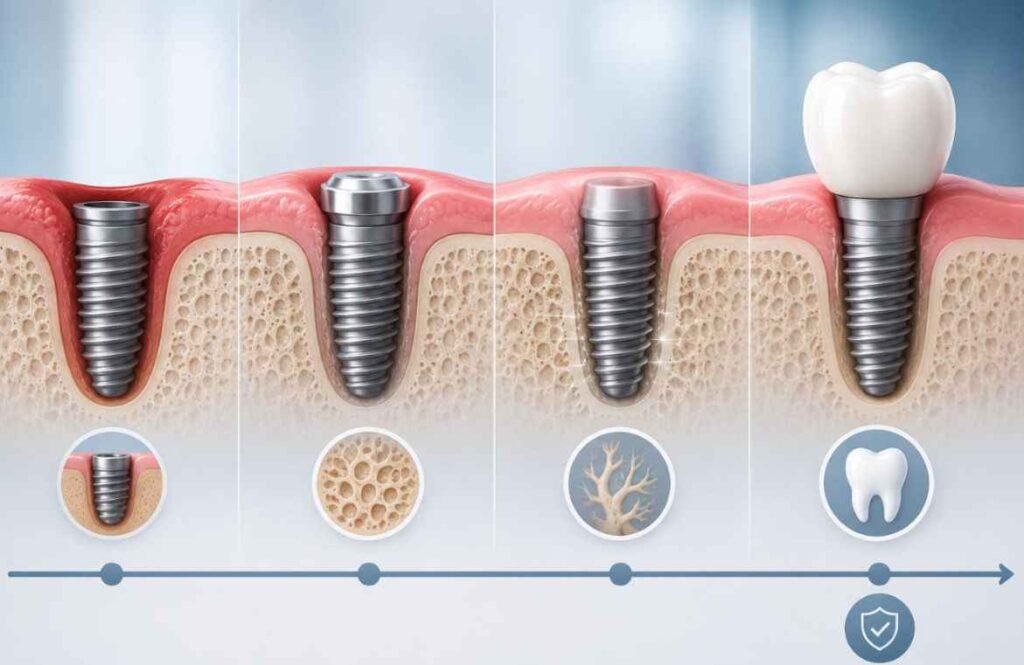
The period between the first and second visits is essential.
During this time, the implant undergoes a biological process called osseointegration. This is where the surrounding bone forms a stable connection with the implant surface.
The process commonly takes several months, although the duration varies between patients.
What Happens During Healing?
During the healing period:
- The gum tissue recovers from surgery.
- Bone gradually integrates with the implant.
- The dentist monitors the healing process.
- Temporary restorations may be adjusted if necessary.
- The patient follows an appropriate oral hygiene routine.
The patient should also follow any dietary restrictions and avoid putting excessive pressure on the surgical area.
How Long Should You Wait Between Visits?
There is no fixed waiting period for every patient.
The time depends on:
- Bone quality.
- Implant location.
- Implant stability.
- Whether bone grafting was performed.
- General health.
- Individual healing response.
Many conventional cases require approximately three to six months before the final restoration, but some cases may need more time.
Your dentist should determine the timing based on clinical findings rather than a predetermined travel package schedule.
Second Visit: Final Dental Crowns and Restorations

The second visit focuses on completing the restorative stage.
Before fitting the final teeth, the dentist should assess whether the implant has healed sufficiently.
1. Implant Assessment
The dentist checks the condition of the implant and surrounding tissues.
This may involve:
- Reviewing the healing process.
- Examining the gum tissue.
- Assessing implant stability using appropriate clinical methods.
- Taking additional X-rays when indicated.
- Confirming that the implant is ready for restoration.
If healing is incomplete, the dentist may recommend delaying the final restoration.
2. Digital Scans or Impressions
Once the implant is considered ready, the dentist obtains the information needed to manufacture the final restoration.
This may involve digital scanning or conventional impressions.
The dentist considers:
- Tooth shape.
- Tooth colour.
- Bite alignment.
- Gum appearance.
- Spacing between teeth.
- The patient’s functional and aesthetic requirements.
3. Final Crown or Bridge Design
The permanent restoration is designed to fit the implant and work comfortably with the surrounding teeth.
Depending on the treatment, it may be:
- A single implant crown.
- An implant-supported bridge.
- A full-arch restoration.
- Another customised prosthetic solution.
4. Final Fitting and Bite Adjustment
The final restoration is fitted and checked.
The dentist should assess:
- Fit and stability.
- Bite alignment.
- Chewing comfort.
- Appearance.
- Gum health.
- Oral hygiene access.
Patients should receive instructions on caring for their new restorations before returning home.
Two-Visit Dental Implants: Example Treatment Timeline
The following is an illustrative example of a conventional treatment plan. Your actual schedule may be different.
- First visit – Initial assessment and surgeryExamination, scans, treatment planning and implant placement.
- Early recovery – First 1–2 weeksGum healing, post-operative care and any planned follow-up checks.
- Healing period – Following monthsOsseointegration and monitoring of implant healing.
- Second visit – Restorative treatmentImplant assessment, scans or impressions, and final restoration when clinically appropriate.
- After treatment – Ongoing maintenanceRegular dental reviews and professional cleaning as recommended.
What Can Increase the Number of Visits?
Although two visits are common in many conventional treatment plans, some patients need additional appointments.
Bone Grafting
If there is insufficient jawbone volume, bone grafting may be necessary.
Depending on the case, grafting can be performed at the same time as implant placement or as a separate procedure.
Sinus Lift
Patients who need implants in the upper back jaw may require a sinus lift if there is insufficient bone height.
This procedure may affect the overall treatment schedule.
Complex Full-Mouth Treatment
Patients receiving multiple implants or full-mouth rehabilitation may need additional assessments and adjustments.
Healing Complications
If the implant does not heal as expected, the dentist may need to investigate the cause and modify the treatment plan.
It is important not to proceed with the final restoration until the dentist considers it appropriate.
How Should You Prepare for Your First Trip to Turkey?
Planning ahead can make your dental treatment journey more organised.
Before travelling, consider the following:
- Send recent dental records if available.
- Share your medical history and medication list.
- Ask whether a CBCT scan is required.
- Request a written treatment plan.
- Confirm the expected length of your stay.
- Understand what is included in the treatment price.
- Ask about post-operative appointments.
- Confirm who will provide support after you return home.
Do not rely on a price quotation alone. The clinical details of the proposed treatment are equally important.
What Should You Plan Before Your Second Trip?
The second trip should be arranged after your dentist confirms that the implant is ready for restoration.
Before booking flights, ask:
- Has the implant integrated sufficiently?
- Is the gum tissue healthy?
- Are additional scans required?
- How many appointments will be needed?
- How long should I stay in Turkey?
- What happens if the final restoration needs adjustment?
- What follow-up arrangements are available after I return home?
Allow enough flexibility in your travel schedule in case additional clinical checks or adjustments are needed.
Are Two-Visit Dental Implants Better Than One-Visit Treatment?
Neither approach is automatically better for every patient.
The appropriate treatment depends on the clinical circumstances.
| Consideration | Two-visit approach | Selected immediate-loading approach |
|---|---|---|
| Treatment stages | Surgery and final restoration are separated | Temporary restoration may be provided soon after surgery |
| Healing | Time is allowed before final restoration | Loading decisions depend on clinical stability |
| Suitability | Common in conventional treatment | Suitable only for selected cases |
| Travel planning | Usually requires separate trips | May reduce initial treatment visits |
| Final teeth | Fitted after healing assessment | Permanent teeth may still require a later stage |
The dentist should recommend the treatment approach based on clinical suitability, not simply the number of trips.
How Much Do Two-Visit Dental Implants in Turkey Cost?
The total price depends on the treatment required and the materials and services included.
Factors that may influence the cost include:
- Number of implants.
- Implant manufacturer.
- Type of final restoration.
- Bone grafting requirements.
- Tooth extractions.
- Temporary teeth.
- Diagnostic imaging.
- Number of clinical appointments.
- Follow-up arrangements.
When comparing treatment quotations, ask whether the price covers both visits, temporary restorations, final crowns, any additional procedures and aftercare.
A low initial quotation may not represent the total cost of completing treatment.
Frequently Asked Questions
Do dental implants in Turkey always require two visits?
No. Some patients may be suitable for different treatment protocols. However, conventional implant treatment commonly involves implant placement followed by a healing period and a later restorative appointment.
How many months are there between the two visits?
Many conventional cases require approximately three to six months, although the exact period depends on healing, bone quality and additional procedures.
Will I have teeth after my first visit?
Some patients can receive temporary teeth during the first visit. Others may need to wait or use a different temporary solution.
Are the teeth fitted during the second visit permanent?
They are intended to be the final restorations, but the dentist must first confirm that the implants have healed sufficiently and that the restoration is clinically suitable.
Can I return to the UK after the first visit?
Many patients travel home after the initial surgical stage, subject to their dentist’s advice and recovery. Follow-up arrangements should be agreed before travelling.
What happens if my dental implant does not heal properly?
The dentist should assess the implant, investigate possible causes and explain the available options. The final restoration may need to be delayed or the treatment plan changed.
Can I have full-mouth dental implants in two visits?
Some patients may complete the main surgical and restorative stages over two visits. However, complex cases may require additional procedures or appointments.
Final Thoughts: Planning Two Visits for Dental Implants in Turkey
Two-visit dental implant treatment can provide a structured approach for international patients.
The first visit usually focuses on examination and implant placement, while the second visit is arranged after the healing period to complete the final restoration.
The time between appointments is not wasted time. It allows the implant to integrate with the jawbone and gives the dentist an opportunity to assess healing before fitting the permanent teeth.
If you are considering dental implants in Turkey, ask for a personalised treatment plan that clearly explains the number of visits, expected healing period, total cost and long-term follow-up arrangements.
Planning dental implant treatment in Turkey? Contact our team to discuss your dental condition and receive an individual treatment assessment.